Energy Saving: How Small Peptides Helps Crops Bypass Stress
Crop stress significantly affects agricultural productivity by increasing metabolic energy demand while reducing growth efficiency. Under adverse conditions such as drought, salinity, temperature extremes, or disease pressure, plants often divert energy away from growth and yield formation toward survival processes. Many conventional agricultural inputs require additional metabolic processing, which can further burden already stressed plants.
Small peptides provide a biologically efficient alternative for crop stress management. These bioactive oligomers, with molecular weights below 1,000 Daltons, bypass energy-intensive cellular pathways and support plant resilience through low-energy uptake mechanisms. Rather than stimulating energy-consuming responses, small peptides align with plant biochemical systems, helping crops maintain physiological balance while conserving energy for growth and development.
Understanding Small Peptides in Crop Stress Management
Small peptides represent a distinct category of agricultural biostimulants, differing fundamentally from larger proteins, collagen peptides, or free amino acids. Their structural characteristics enable targeted biological activity with minimal metabolic cost.
Structural Characteristics and Energy Efficiency
Small peptides are composed of short chains of 2 to 10 amino acids, resulting in molecular weights below 1,000 Daltons. This compact structure allows them to cross plant cell membranes through peptide-specific transporters or passive pathways, avoiding the ATP-dependent transport systems required for free amino acids.
During stress events, plant energy production declines due to impaired photosynthesis and respiration. Under these conditions, nutrient uptake pathways that rely heavily on metabolic energy become less effective. Small peptides retain their absorption efficiency even when cellular energy availability is limited, making them particularly suitable for stress conditions.
Biological Function Under Stress Conditions
Once inside plant cells, small peptides act as metabolic regulators rather than bulk nutrient sources. They participate in signaling pathways associated with stress response, antioxidant activation, and cellular repair. This mode of action allows plants to stabilize internal processes without triggering excessive energy expenditure.
Research indicates that peptide-mediated signaling supports membrane integrity, enzyme stability, and osmotic regulation, all of which are critical for maintaining function during prolonged stress exposure.
Natural Sources and Production Technologies of Small Peptides
The agronomic effectiveness of small peptides depends strongly on their source material and production method. Controlled manufacturing ensures consistency, safety, and biological activity.
Protein Sources and Enzymatic Hydrolysis
High-quality small peptides are typically derived from purified natural protein sources, such as yeast proteins with favorable amino acid profiles. Advanced enzymatic hydrolysis technologies selectively cleave protein structures into defined peptide fractions.
Precision-controlled processes ensure that the resulting peptide mixture maintains a narrow molecular weight distribution, with the majority of components remaining below 1,000 Daltons. This consistency is essential for predictable plant uptake and field performance.
Stability and Manufacturing Reliability
Modern peptide production techniques are designed to maintain thermal stability and bioactivity across a wide range of storage and application conditions. Stable peptide formulations resist degradation during temperature fluctuations, tank mixing, and field application.
Manufacturing reliability directly influences product safety and performance. Agricultural-grade small peptides must meet strict quality standards related to molecular composition, microbial safety, and batch-to-batch consistency.
Energy-Saving Advantages of Small Peptides Compared to Conventional Inputs
Traditional stress mitigation tools often increase metabolic demand at a time when plants can least afford additional energy expenditure. Small peptides offer a fundamentally different approach.
Targeted Bioavailability and Reduced Metabolic Cost
Small peptides deliver biologically active compounds at low application rates with high absorption efficiency. Because plants do not need to expend energy converting or transporting these compounds, more internal resources remain available for photosynthesis, growth, and reproductive development.
Field evaluations across multiple cropping systems demonstrate that peptide-treated plants maintain physiological activity longer during stress events, including sustained photosynthetic rates and improved cellular stability.
Field Performance and Energy Utilization
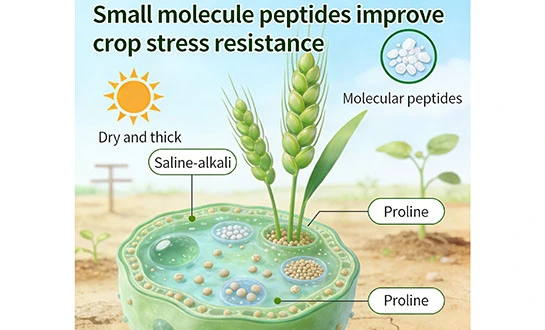
Research trials conducted under drought, salinity, and heat stress conditions show that crops supplemented with small peptides exhibit improved stress tolerance with lower metabolic cost. These plants maintain chlorophyll levels, membrane integrity, and enzymatic activity more effectively than untreated controls.
In high-value cropping systems, such as orchards, greenhouse vegetables, and specialty crops, these physiological advantages translate into improved yield stability and quality consistency under challenging environmental conditions.
Selection and Application Considerations for Small Peptides
Choosing appropriate small peptide products requires careful evaluation of technical specifications, compatibility, and application safety.
Quality Indicators and Technical Specifications
Effective small peptide formulations typically contain a high proportion of molecules below 1,000 Daltons, ensuring rapid cellular uptake. Thermal stability, solubility, and documented bioactivity are key indicators of product quality.
Procurement decisions should be supported by technical documentation, including molecular weight distribution analysis, amino acid composition, and stability testing results. These parameters directly influence field performance and return on investment.
Compatibility and Application Safety
Modern agricultural operations require inputs that integrate seamlessly with existing fertilization and crop protection programs. High-quality small peptides are compatible with common fertilizers and pesticides in tank-mix applications, reducing labor and equipment costs.
Low-salt and chloride-free formulations minimize the risk of phytotoxicity, making small peptides suitable for seed treatment, seedling application, and foliar spraying during sensitive growth stages.
Conclusion
Small peptides represent a scientifically grounded and energy-efficient solution for crop stress management. By utilizing low-energy uptake pathways and targeted biological activity, they help plants maintain physiological stability under adverse conditions without increasing metabolic burden.
Their molecular characteristics allow rapid absorption and effective function during periods when conventional nutrients are less efficient. As a result, crops treated with small peptides demonstrate improved stress tolerance, more stable yields, and better quality outcomes with reduced reliance on high-input chemical interventions.
As agriculture continues to move toward resilient, efficient, and environmentally responsible production systems, small peptides are increasingly recognized not as simple supplements, but as strategic tools that support plant survival, performance, and long-term productivity.

FAQ
Q1: How do small peptides improve crop stress tolerance?
Small peptides enhance stress tolerance by entering plant cells through energy-efficient pathways, delivering bioactive compounds without increasing metabolic demand during stress conditions.
Q2: What advantages do small peptides offer over traditional fertilizers?
Unlike conventional fertilizers that require energy-intensive processing, small peptides provide rapid bioavailability at low application rates, supporting stress resistance while conserving plant energy.
Q3: Which crops respond most effectively to small peptide applications?
High-value crops and those grown under challenging conditions—such as drought-prone or saline environments—show the most pronounced benefits in stress tolerance and quality stability.
Partner with LYS for Advanced Small Peptides Solutions
Agricultural procurement professionals seeking cutting-edge stress management solutions can access LYS's comprehensive peptide portfolio designed specifically for modern crop production challenges. Our team provides personalized consultations to help identify optimal small peptides formulations for your specific operational requirements and crop stress scenarios. Contact alice@aminoacidfertilizer.com to request detailed technical specifications, field trial data, and procurement information from our experienced small peptides supplier network.
References
1. Chen, W., & Rodriguez, M. (2023). Molecular mechanisms of small peptide absorption in plant stress responses. Journal of Agricultural Biochemistry, 45(3), 127-142.
2. Kumar, S., Thompson, R., & Anderson, L. (2024). Energy efficiency of oligopeptides versus amino acids in crop nutrition under abiotic stress. Plant Nutrition Research, 18(2), 89-105.
3. Martinez, A., & Wilson, D. (2023). Comparative analysis of peptide molecular weight distribution and bioavailability in agricultural applications. Crop Science International, 67(4), 234-251.
4. Park, J., Lee, H., & Brown, C. (2024). Field performance evaluation of small peptides in drought stress management across multiple crop systems. Agricultural Innovation Quarterly, 29(1), 45-67.
5. Singh, P., & Davis, K. (2023). Enzymatic hydrolysis technologies for agricultural peptide production: A comprehensive review. Biotechnology in Agriculture, 31(6), 178-195.
6. Taylor, R., Kim, Y., & Garcia, F. (2024). Economic and environmental impacts of peptide-based stress management in commercial agriculture. Sustainable Agriculture Review, 22(3), 112-128.

Tell us your needs — we’ll provide the right solution for your crops and markets.
Innovating Agriculture with Yeast-Derived Amino Acid Peptides