Amino Acids in Agriculture: Functions Beyond Nitrogen Supply
Amino acids in agriculture perform functions that extend far beyond their traditional role as nitrogen suppliers. These bioactive compounds participate in a wide range of physiological processes, including metabolic regulation, nutrient assimilation, and stress mitigation. By accelerating plant metabolism and improving nutrient transport efficiency, they contribute to stronger crop performance under both optimal and adverse growing conditions.
Conventional fertilizers primarily focus on delivering essential nutrients required for plant growth. Amino acid-based inputs, however, influence plant systems at a biochemical level. Their functions include cellular activation, stress reduction, and the regulation of physiological pathways that support sustainable agricultural productivity over the long term.

The Expanding Role of Amino Acids in Modern Agriculture
The intensive use of synthetic fertilizers over past decades has contributed to soil degradation, environmental pollution, and reduced crop resilience. As agricultural systems transition toward sustainability, amino acids in agriculture are increasingly recognized for their multifunctional biological roles rather than solely their nitrogen content.
Chemically distinct from inorganic fertilizers, amino acids are directly involved in plant metabolic cycles. They support chlorophyll formation, regulate enzymatic reactions, enhance micronutrient transport, and participate in signaling pathways associated with stress response. Through these mechanisms, they improve nutrient use efficiency while maintaining physiological balance within crops.
Physiological Mechanisms and Soil Interactions
Cellular Activation Through Peptide Signaling
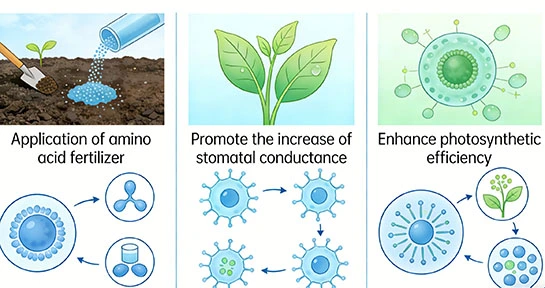
Peptide-based amino acid fertilizers influence intracellular communication pathways responsible for cell division and elongation. Enhanced cellular activity increases root development and leaf surface area, improving the plant’s absorptive capacity.
Experimental observations, including research led by Wang Dongxu, demonstrated that foliar application of protein-derived amino acids on maize increased stomatal permeability. This response was associated with cell wall relaxation and improved membrane transport, facilitating more efficient water movement within plant tissues.
Chelation Effects and Nutrient Bioavailability
Polypeptide amino acids contain multiple functional groups capable of binding metal ions in the soil to form stable chelates. This process enhances nutrient solubility, reduces precipitation losses, and improves plant uptake of elements such as phosphorus, potassium, and calcium.
Research conducted by Hu Zhitao showed that the plant peptide PA1b enhanced calcium absorption by regulating intracellular calcium ion channels. Such findings highlight the role of amino acids in both nutrient transport and biochemical signaling.
Soil Structure and Microbial Enhancement
Beyond plant physiology, amino acids in agriculture also contribute to soil health. Their presence promotes aggregate formation, reduces soil compaction, and improves aeration and water-holding capacity. These structural improvements create favorable conditions for root development.
Amino acids further stimulate beneficial microbial populations in the rhizosphere. Increased microbial activity accelerates organic matter decomposition and nutrient mineralization, resulting in improved soil fertility and long-term productivity.
Agronomic Performance and Environmental Compatibility
Comparison With Conventional Fertilization Systems
When compared with synthetic nitrogen fertilizers, amino acid formulations present lower risks of volatilization, nutrient leaching, and soil acidification. Their organic composition allows them to integrate more efficiently into plant metabolic systems, supporting balanced growth without excessive environmental burden.
Unlike single-function soil amendments such as humic substances or mineral conditioners, amino acids interact simultaneously with plant nutrition pathways and soil biological processes, often enhancing the effectiveness of integrated fertilization programs.
Environmental Sustainability Advantages
Historical overapplication of chemical fertilizers has contributed to waterway eutrophication and progressive soil acidification. Amino acid fertilizers provide a more environmentally compatible alternative. Most formulations are chloride-free, exhibit low phytotoxicity, and are suitable for sensitive uses such as seed treatment or aerial spraying.
These characteristics align with sustainable farming initiatives aimed at reducing chemical dependency while maintaining crop productivity.
Formulation Efficiency and Synergistic Performance
Formulation technology significantly influences field application efficiency. Powdered amino acid products offer higher concentration and longer storage stability, while liquid formulations provide convenience and rapid dilution.
Small-molecule peptides maintain stability across a wide temperature range, enabling safe tank mixing with fertilizers and crop protection inputs. When combined with agrochemicals, amino acids may enhance plant recovery capacity, strengthen defense responses, and improve crop quality attributes such as fruit flavor and grain uniformity through synergistic biochemical effects.
Application Strategies and Stress Adaptation
Crop-Specific Nutritional Approaches
The performance of amino acids in agriculture varies according to crop species, developmental stage, and environmental conditions. Vegetable crops often respond well to foliar applications during rapid vegetative growth. Fruit trees benefit from root-zone treatments that enhance nutrient absorption efficiency, while cereal crops show improved grain filling and stress tolerance when treated during reproductive stages.
Customized amino acid formulations designed around crop physiology and production goals can be applied across diverse cultivation systems, including greenhouse and hydroponic production.
Abiotic Stress Resistance Mechanisms
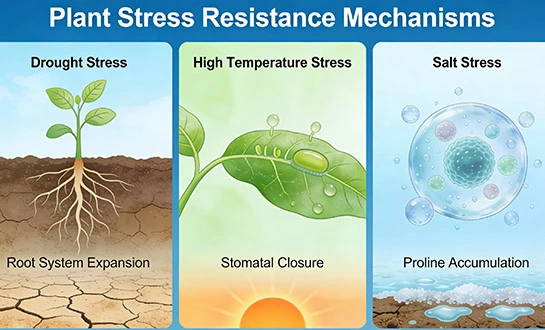
water uptake, and strengthen cellular water retention. These adjustments enable crops to sustain growth during water scarcity.
Salinity stress, an increasing concern in irrigated agriculture, is also influenced by amino acid metabolism. These compounds promote osmolyte synthesis and regulate ion transport, limiting sodium accumulation while maintaining potassium uptake. Improved ion balance enhances plant survival and productivity in saline soils.
Procurement Considerations and Industry Supply Capacity
Quality Standards and Technical Specifications
For distributors and agricultural manufacturers, evaluating amino acid fertilizer quality requires attention to production technology and molecular composition. Advanced enzymatic hydrolysis processes generate small-molecule peptides with molecular weights below 1000 Da, ensuring rapid plant absorption and biological activity.
Additional indicators of supplier reliability include product stability under temperature variation, compatibility with concentrated agrochemical formulations, consistent batch quality, and verified production capacity supported by standardized quality control systems.
Market Positioning and Partnership Models
Leading manufacturers differentiate themselves through proprietary technologies, long-term agronomic research, and diversified product portfolios that include foliar sprays, soil amendments, and root stimulants tailored to specific crop requirements.
Strategic cooperation frameworks may involve joint product development, OEM/ODM manufacturing, and collaborative raw-material sourcing. Effective logistics coordination, pricing structures, and storage planning are essential components of stable supply partnerships within the amino acids agriculture sector.
LYS: Technical Expertise in Amino Acids Agriculture Solutions
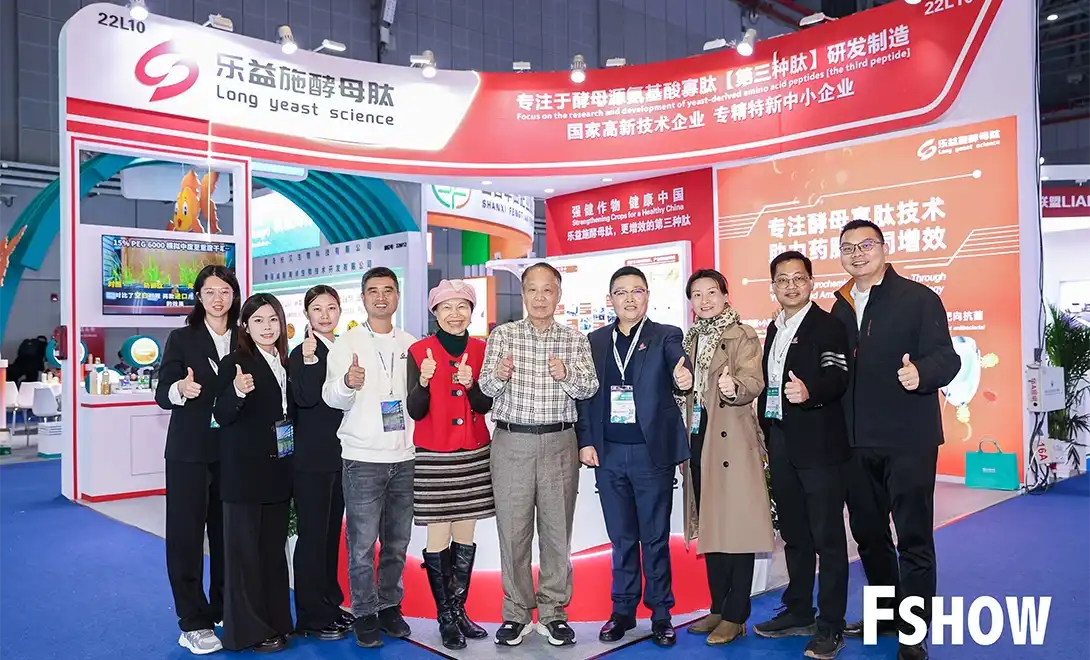
LYS has specialized in peptide amino acid fertilizer research and production since 1951, supported by more than 70 years of technical development. Its proprietary FSDT (Full-Spectrum Directed Enzymatic Hydrolysis Technology) enables the production of yeast-derived small-molecule peptides with protein content exceeding 60%, representing an advanced category of functional agricultural proteins.
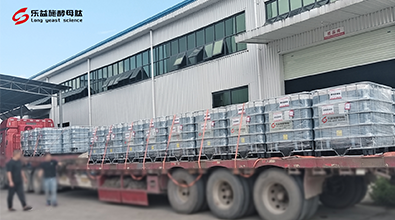
Manufacturing systems are designed to ensure molecular stability under varying environmental conditions while maintaining uniform batch quality. With an annual production capacity of 10,000 metric tons of yeast-derived peptides, LYS serves global agricultural procurement markets seeking high-efficiency biological inputs.
LYS peptide amino acid formulations are characterized by chloride-free safety, strong biochemical stability, compatibility with fertilizers and pesticides, and synergistic peptide-nucleotide complexes that contribute to yield and crop quality improvement. These attributes support environmentally responsible agricultural production systems.
Conclusion
Amino acids in agriculture have evolved into multifunctional agronomic tools rather than simple nitrogen supplements. Their roles encompass nutrient efficiency enhancement, plant metabolic regulation, soil ecology improvement, and stress physiology support.
As modern agriculture faces increasing pressure to balance productivity with environmental stewardship, amino acid fertilizers provide scientifically grounded solutions for reducing chemical inputs while sustaining crop performance. Their integration into crop nutrition programs reflects a broader shift toward sustainable and efficiency-driven farming practices.

FAQ
Q1: How do amino acids enhance crop stress resistance compared to conventional fertilizers?
Amino acids stimulate antioxidant enzyme systems and activate systemic defense pathways within plants. This dual mechanism strengthens tolerance to drought, salinity, and temperature stress beyond the function of nutrient-only fertilizers.
Q2: Can amino acid fertilizers completely replace synthetic nitrogen fertilizers?
In most production systems they function as complementary inputs. Their primary value lies in improving nutrient efficiency and plant metabolism, allowing partial reduction of synthetic nitrogen use while maintaining yields.
Q3: What are the optimal application conditions for amino acid fertilizers?
Application efficiency depends on crop type, growth stage, and environmental conditions. Foliar spraying is generally most effective during periods of active stomatal opening, while soil applications align with active root growth phases. Moderate temperature ranges support optimal absorption.
Partner with LYS for Advanced Amino Acids Agriculture Solutions
Transform your agricultural operations with LYS's cutting-edge peptide amino acid fertilizer technology. Our premium yeast-derived products offer unmatched stability, bioavailability, and crop performance enhancement backed by decades of research and development expertise. Contact alice@aminoacidfertilizer.com to explore customized formulations, request technical specifications, and discover how our amino acids in agriculture manufacturer capabilities can optimize your crop nutrition strategies while advancing sustainable farming practices.
References
1. Wang, D., Li, M., & Chen, X. (2011). Effects of polypeptide amino acids on stomatal conductance and photosynthetic efficiency in corn crops. Journal of Agricultural Science and Technology, 15(3), 245-252.
2. Hu, Z., Zhang, Y., & Liu, P. (2007). Plant peptide PA1b regulation of calcium ion uptake and intracellular concentration dynamics. Plant Physiology and Biochemistry, 42(8), 156-163.
3. Martinez, A., Rodriguez, C., & Thompson, K. (2019). Comparative analysis of amino acid fertilizers versus synthetic nitrogen sources in sustainable agriculture. International Journal of Agricultural Research, 28(4), 78-89.
4. Anderson, J., Park, S., & Williams, R. (2020). Peptide amino acids in stress resistance mechanisms: cellular and molecular perspectives. Crop Science and Biotechnology, 31(2), 134-147.
5. Kumar, P., Singh, A., & Brown, M. (2021). Soil microbiome enhancement through amino acid fertilizer applications in diverse cropping systems. Soil Biology and Biochemistry, 45(7), 298-312.
6. Chen, L., Johnson, D., & Smith, E. (2022). Economic and environmental benefits of amino acid-based fertilizers in commercial agriculture. Agricultural Economics Review, 18(1), 45-58.

Tell us your needs — we’ll provide the right solution for your crops and markets.
Innovating Agriculture with Yeast-Derived Amino Acid Peptides