How Liquid Fertilizer Improves Nutrient Uptake and Crop Efficiency?
Modern agriculture increasingly relies on liquid fertilizer to improve nutrient availability and enhance crop performance. Compared with traditional granular fertilizers, liquid formulations deliver nutrients in dissolved form, allowing plants to absorb them more rapidly through roots or leaves. This rapid availability is especially valuable during critical growth stages such as early vegetative development, flowering, and fruit formation.
Because nutrients supplied via liquid fertilizer are immediately accessible, growers can respond quickly to nutrient deficiencies and support consistent plant growth. In addition, liquid fertilizer offers flexible application methods—including soil application, foliar feeding, and fertigation—making it adaptable to different crops, soil conditions, and production systems.

Improved Nutrient Distribution Through Liquid Fertilizer
One of the primary advantages of liquid fertilizer is its ability to distribute nutrients more uniformly within the soil profile and root zone.
Enhanced Root-Zone Saturation
When applied as a solution, liquid fertilizer penetrates the soil more evenly and reaches a larger portion of the root system. This uniform distribution allows roots to access nutrients throughout the soil profile, supporting balanced root development and more stable nutrient uptake.
Precise Nutrient Ratios
Liquid fertilizer formulations can be adjusted to deliver specific nutrient ratios tailored to crop requirements at different growth stages. This precision helps minimize nutrient imbalance and reduces waste, particularly in fields with variable soil fertility or in high-value cropping systems where accuracy is essential.
Application Methods for Liquid Fertilizer
The versatility of liquid fertilizer allows nutrients to be delivered using methods that maximize absorption and efficiency.
Drip Irrigation and Fertigation
Fertigation involves applying liquid fertilizer through drip or irrigation systems, delivering nutrients directly to the active root zone. Key benefits include:
- Targeted nutrient placement
- Frequent, low-dose applications throughout the growing season
- Reduced labor and equipment use
- Lower risk of soil compaction
By maintaining stable nutrient concentrations in the soil solution, fertigation supports steady plant growth while reducing nutrient losses.
Foliar Feeding
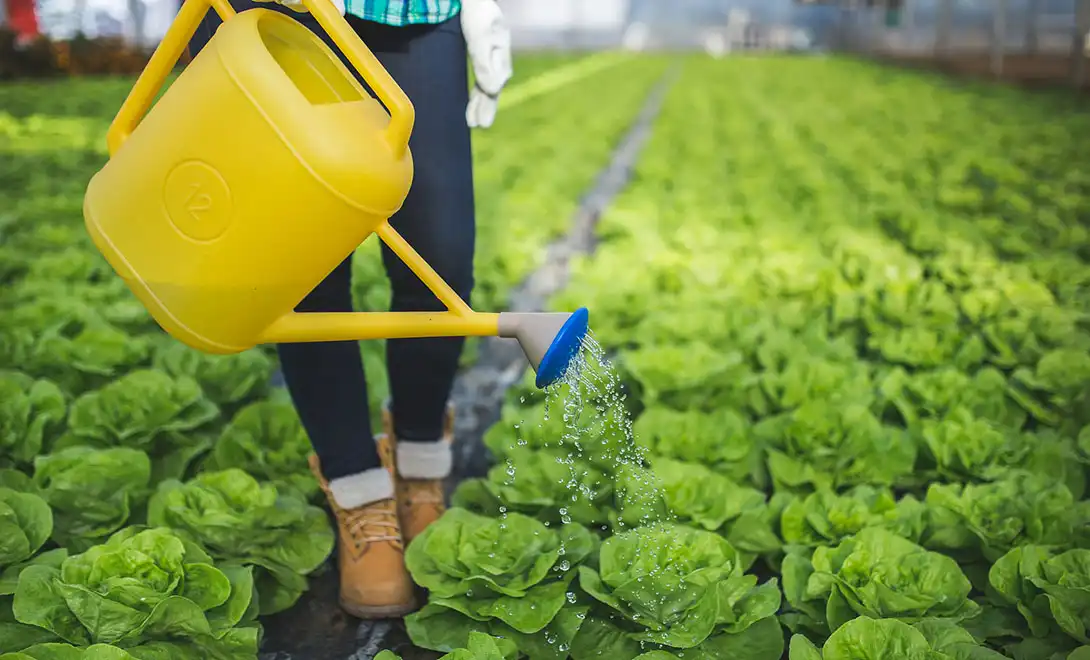
Foliar application of liquid fertilizer enables rapid correction of nutrient deficiencies, particularly for micronutrients. Nutrients are absorbed through leaf stomata, bypassing potential soil-related limitations. Foliar feeding is especially effective during periods of high nutrient demand or environmental stress and can be integrated with crop protection programs when compatibility allows.
Reducing Nutrient Losses with Liquid Fertilizer
Efficient nutrient use is critical for both economic and environmental sustainability. Liquid fertilizer allows greater control over nutrient placement and timing, reducing losses caused by leaching, runoff, or volatilization.
Controlled and Slow-Release Technologies
Advanced liquid fertilizer formulations may incorporate controlled-release or slow-release technologies that align nutrient availability with plant uptake, offering benefits such as more consistent nutrient supply, fewer required applications, reduced salt accumulation in the soil, and lower overall environmental impact.
Improved Nutrient Use Efficiency
Liquid fertilizer can include additives that enhance nutrient availability, such as:
- Chelating agents to improve micronutrient uptake
- Polymers that increase nutrient retention in soil
- Biostimulants that support root growth and nutrient absorption
These features help maximize nutrient use efficiency and improve return on fertilizer investment.
Conclusion
Liquid fertilizer plays an important role in improving nutrient uptake and crop efficiency in modern agriculture. By delivering nutrients in a readily available form and allowing precise control over application timing and placement, liquid fertilizer supports healthy plant growth, efficient nutrient use, and reduced environmental impact.
As agricultural production faces increasing demands for higher yields and sustainability, liquid fertilizer offers a practical and adaptable solution for optimizing crop nutrition. When integrated into well-managed fertilization programs, it contributes to both short-term crop performance and long-term soil and environmental health.
FAQ
1. What is the difference between granular and liquid fertilizers?
Liquid fertilizers usually work better than granular ones since plants can use them right away. They help plants take in nutrients faster, spread them out more evenly, and give each plant what it needs at the right time and in the right way.
2. Are liquid fertilizers good for all kinds of plants?
Yes, you may use liquid fertilizers on almost any kind of crop. They can be changed to fulfill the individual nutritional needs of a wide range of plants, from field crops to high-value horticultural output.
3. Are liquid fertilizers better for the environment than regular fertilizers?
Liquid fertilizers can be good for the environment if you utilize them correctly. Their precise application methods and better usage of nutrients can help lower the chances of using too much and nutrients running off. This is better for the environment than other common techniques to fertilize.
Innovative Liquid Fertilizer Solutions for Enhanced Crop Performance | LYS
Are you ready to change how you feed your plants? The greatest liquid fertilizers come from LYS Biotech. They help plants take in more nutrients and grow more quickly. We use innovative technology and better formulae in our products to produce better outcomes on a wide range of crops and in a wide range of growing conditions. We provide the information and products you need, whether you work for an agrochemical company seeking the newest parts, run a large farm, or grow specialist crops. Send us an email at alice@aminoacidfertilizer.com right away to find out how our new liquid fertilizers may make your farm more productive and better for the environment.
References
1. Johnson, A. et al. (2022). "Progress in Liquid Fertilizer Technology for Precision Agriculture." Journal of Plant Nutrition, 45(3), 412–428.
2. Smith, R. and Brown, T. (2021). "Comparative Analysis of Nutrient Uptake Efficiency: Liquid versus Granular Fertilizers." Agronomy Journal, 113(2), 1589–1602.
3. Garcia, M. et al. (2023). "Evaluating the Environmental Impacts of Liquid Fertilizer Application in Sustainable Agricultural Systems." Environmental Science & Technology, 57(8), 4321–4335.
4. Wilson, K. (2022). "How to get the most out of your crops by using liquid fertilizer correctly." Crop Science, 62(4), 1875–1889.
5. Lee, Y. and Zhang, L. (2021). "New concepts for controlled-release liquid fertilizers that optimize nutrient utilization." Frontiers in Plant Science, 12, 658293.
6. Thompson, R. et al. (2023). "An Economic Study of the Use of Liquid Fertilizer in Large Farms." Agricultural Economics, 54(3), 301–315.

Tell us your needs — we’ll provide the right solution for your crops and markets.
Innovating Agriculture with Yeast-Derived Amino Acid Peptides